You've done the research.
Ultherapy. Thermage. Ultracol Lift. Possibly all three tabs open at once, trying to figure out which one is the right answer for your skin.
Here's what most treatment comparison guides won't tell you:
There isn't one right answer. Because skin laxity isn't one problem.
Sagging happens across multiple layers simultaneously — the deep structural layer, the dermis, and everything in between. A treatment that reaches one layer doesn't touch the others. Which means choosing between Ulthera, Thermage, and Ultracol Lift isn't really the right question.
The right question is: which layers does your skin actually need addressed — and in what combination?
At Ireraum Clinic in Gangnam, this is exactly where every anti-aging consultation begins. Not with a menu. With a map — of what's happening in your skin, at which depth, and what each treatment can and can't reach.
This guide breaks down all three treatments, what each one actually does, why they work better together, and how to think about which combination is right for your skin.
Why One Treatment Is Never the Whole Answer
Before getting into the treatments themselves, it helps to understand why skin laxity is a multi-layer problem — because this is the foundation of everything that follows.
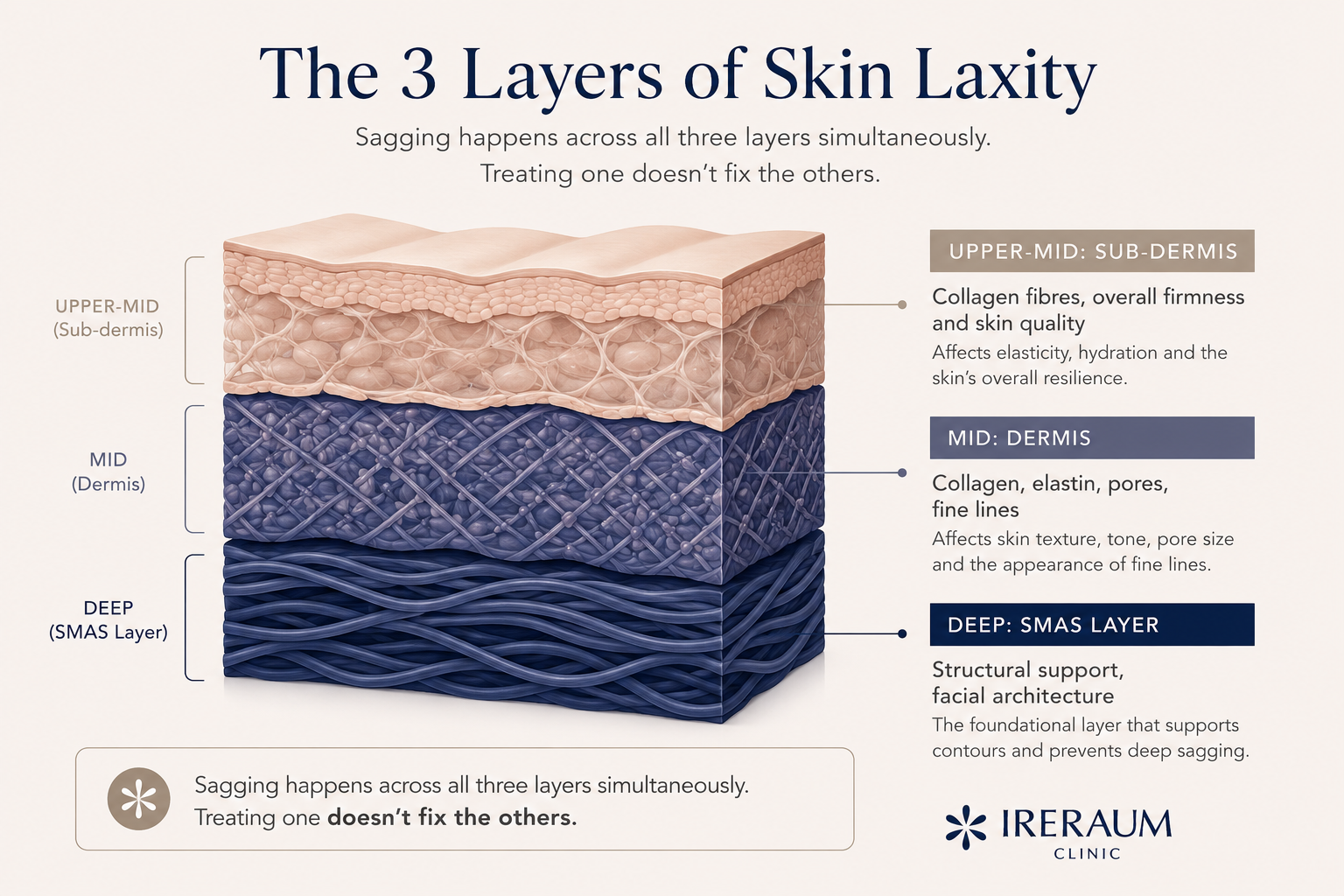
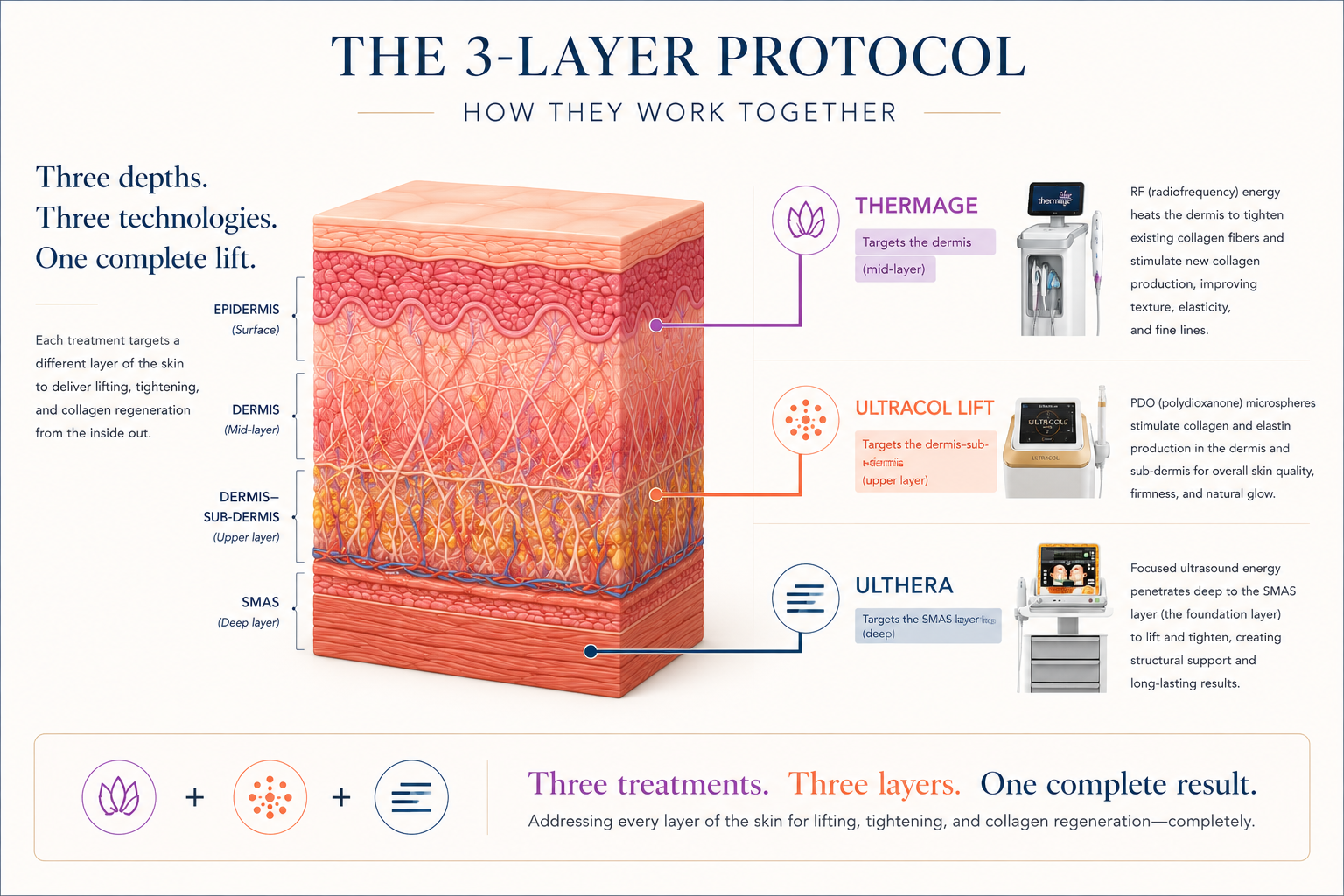
Skin is not a single surface. It's a system of layers, each with a different structure and a different role in maintaining firmness and definition:
The SMAS layer — the deepest structural layer, a fascial membrane that supports the entire face. When this layer loosens, the face loses its foundational architecture. The jawline blurs. The midface descends.
The dermis — the mid-layer where collagen and elastin live. When collagen production declines (which begins in your late 20s and accelerates through your 30s and 40s), the dermis loses density. Fine lines appear. Pores enlarge. Skin feels less resilient.
The sub-dermis — the layer between the dermis and deeper tissue. Collagen fibres here contribute to overall firmness and skin quality. When they weaken, the skin loses the plump, smooth quality associated with youth.
Most lifting treatments target one of these layers. That's not a flaw — it's what makes each one effective at what it does. But it's also why treating only one layer often produces a result that feels incomplete.
The 3 Treatments — What Each One Actually Does
1. Ulthera (Ultherapy) — The Deep Structural Lift
Target layer: SMAS fascia — the deepest non-surgical layer Mechanism: Focused ultrasound energy delivered at precise depths, creating controlled thermal coagulation points at the SMAS layer
Ulthera is the only non-surgical treatment that reaches the SMAS — the same structural layer addressed in surgical facelifts. It uses micro-focused ultrasound to create precise points of thermal injury at depth, triggering a healing response that tightens and lifts the structural foundation of the face.
The result: a lifted facial architecture. The jawline becomes more defined. The midface sits higher. The overall structure of the face feels restored rather than just surface-treated.
What it's best for:
- Significant facial laxity — jawline definition loss, midface descent
- Patients who want the deepest non-surgical lift available
- Structural lifting that holds for 12+ months
What it doesn't address:
- Surface skin quality, texture, or pore appearance
- The collagen decline happening in the dermis and sub-dermis
- The gradual skin quality changes that come with age
2. Thermage — The Dermis Firming Treatment
Target layer: Dermis — the collagen and elastin layer Mechanism: Radiofrequency (RF) energy delivered to the dermis, heating collagen fibres to stimulate tightening and new collagen production
Thermage uses radiofrequency energy to heat the dermal layer — the layer where collagen and elastin fibres live. The heat causes immediate collagen contraction and triggers ongoing collagen remodelling over the following months.
The result: tighter, smoother skin at the surface level. Fine lines soften. Pores appear more refined. Skin feels more elastic and resilient. The face doesn't necessarily lift the way Ulthera lifts — but the quality and texture of the skin itself improves in ways that Ulthera doesn't touch.
What it's best for:
- Fine lines and mild skin laxity
- Enlarged pores and uneven texture
- Improving skin elasticity and surface quality
- Patients who want dermal improvement without structural lifting
What it doesn't address:
- The deep SMAS layer — Thermage doesn't reach structural laxity
- The sub-dermal collagen loss that affects overall skin firmness
- The foundational architectural changes of more significant aging
3. Ultracol Lift — The Collagen Rebuilding Treatment
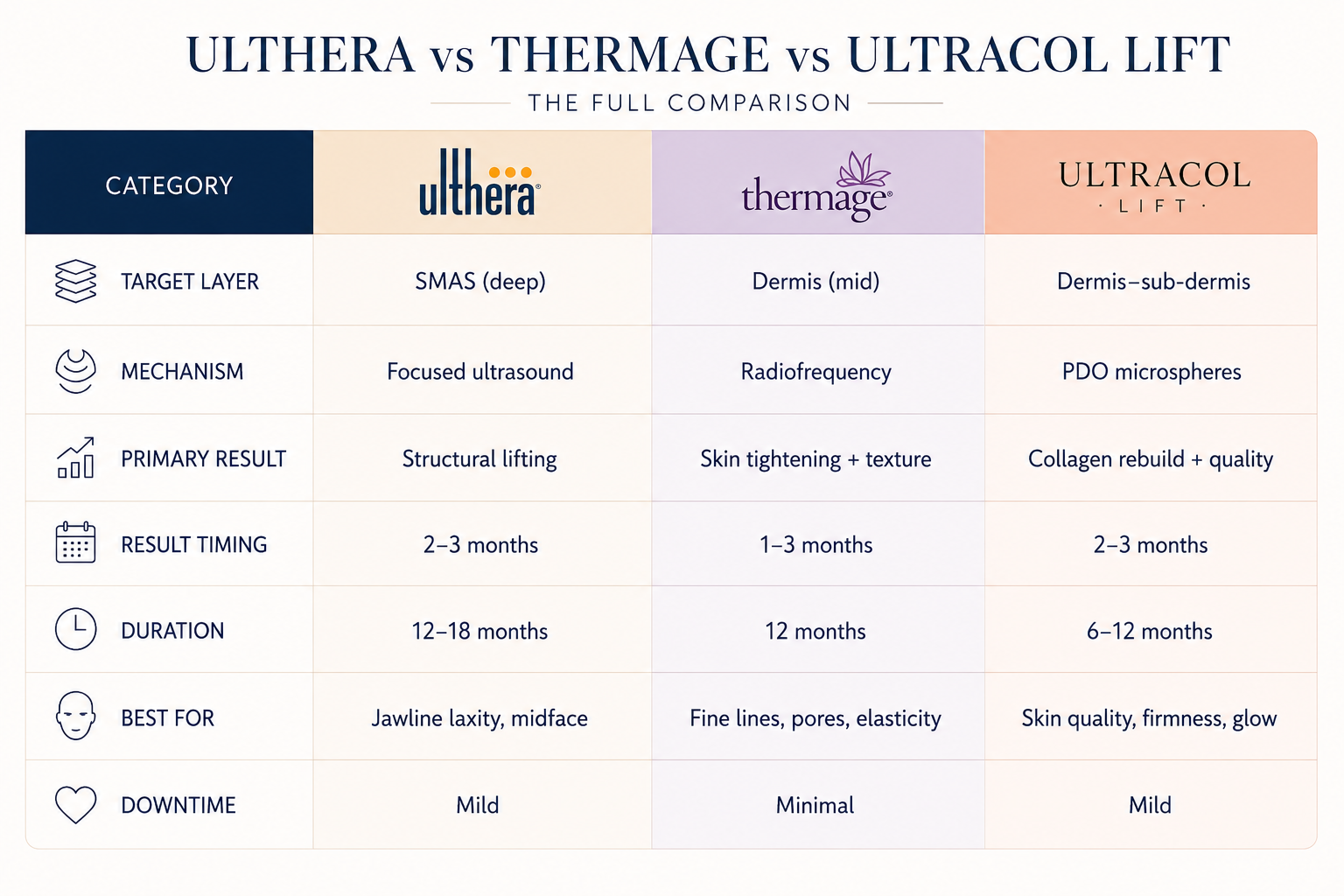
Target layer: Dermis to sub-dermis — the collagen production zone Mechanism: PDO (Polydioxanone) microspheres injected into the skin, stimulating the body's own collagen production as they gradually absorb
Ultracol Lift works differently from both Ulthera and Thermage. Rather than delivering energy to create a lifting or tightening effect, it introduces PDO microspheres that prompt the skin to produce its own new collagen — from within.
As the PDO is gradually absorbed over several months, the collagen matrix it stimulated remains. The result builds over 2–3 months and holds for 6–12 months: improved skin firmness, refined texture, and an overall quality improvement that looks like genuinely healthier skin rather than a treated one.
What it's best for:
- Overall skin quality improvement — firmness, texture, glow
- Patients whose skin feels less resilient or vital than it used to
- Building a collagen foundation that supports and extends the results of other treatments
- Natural, gradual improvement over time
What it doesn't address:
- Structural laxity at the SMAS level
- Significant lifting or architectural repositioning
- The surface-level tightening that Thermage delivers to the dermis directly
Why Combining All Three Works Better Than Choosing One
This is the part most treatment guides skip — because it requires actually understanding how the treatments relate to each other, not just what each one does.
The logic is straightforward once you see it:
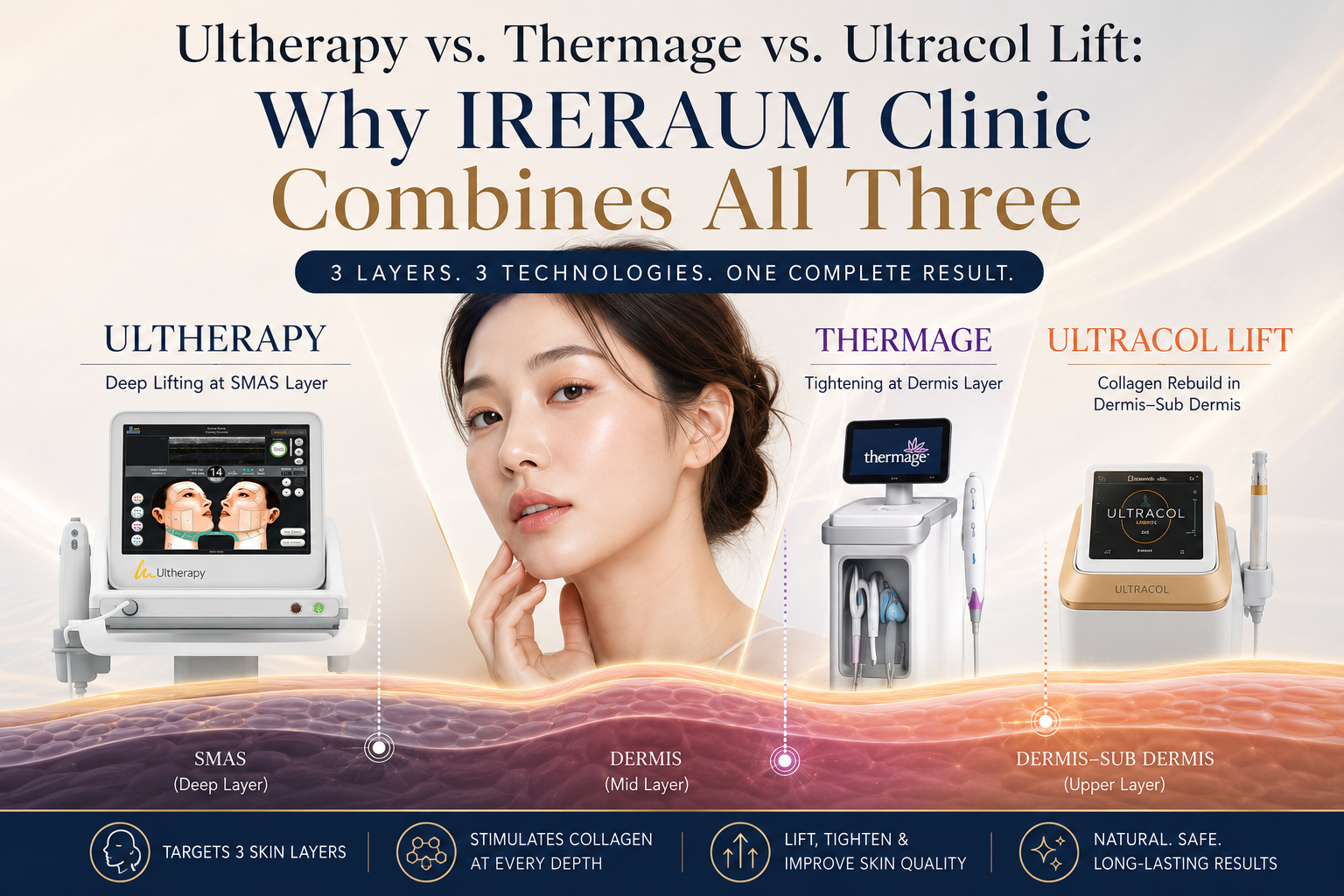
Ulthera lifts the structural foundation. It repositions the deep architecture of the face. But it doesn't improve the quality of the skin sitting on top of that structure.
Thermage tightens and refines the dermal layer. It addresses the fine lines, pores, and surface elasticity that Ulthera doesn't touch. But it doesn't reach the SMAS, and it doesn't rebuild the sub-dermal collagen that contributes to overall skin vitality.
Ultracol Lift stimulates new collagen production across the dermis and sub-dermis. It improves the intrinsic quality of the skin — the firmness, glow, and resilience that come from a genuinely healthy collagen matrix. But it doesn't structurally lift, and it doesn't tighten the surface the way Thermage does.
Together, they cover the full picture:
- Foundation lifted → Ulthera
- Surface tightened and refined → Thermage
- Collagen rebuilt from within → Ultracol Lift
The result of the combination isn't three treatments added together. It's a comprehensive approach to a multi-layer problem — where each treatment does what the others can't.
Which Combination Is Right for Your Skin?
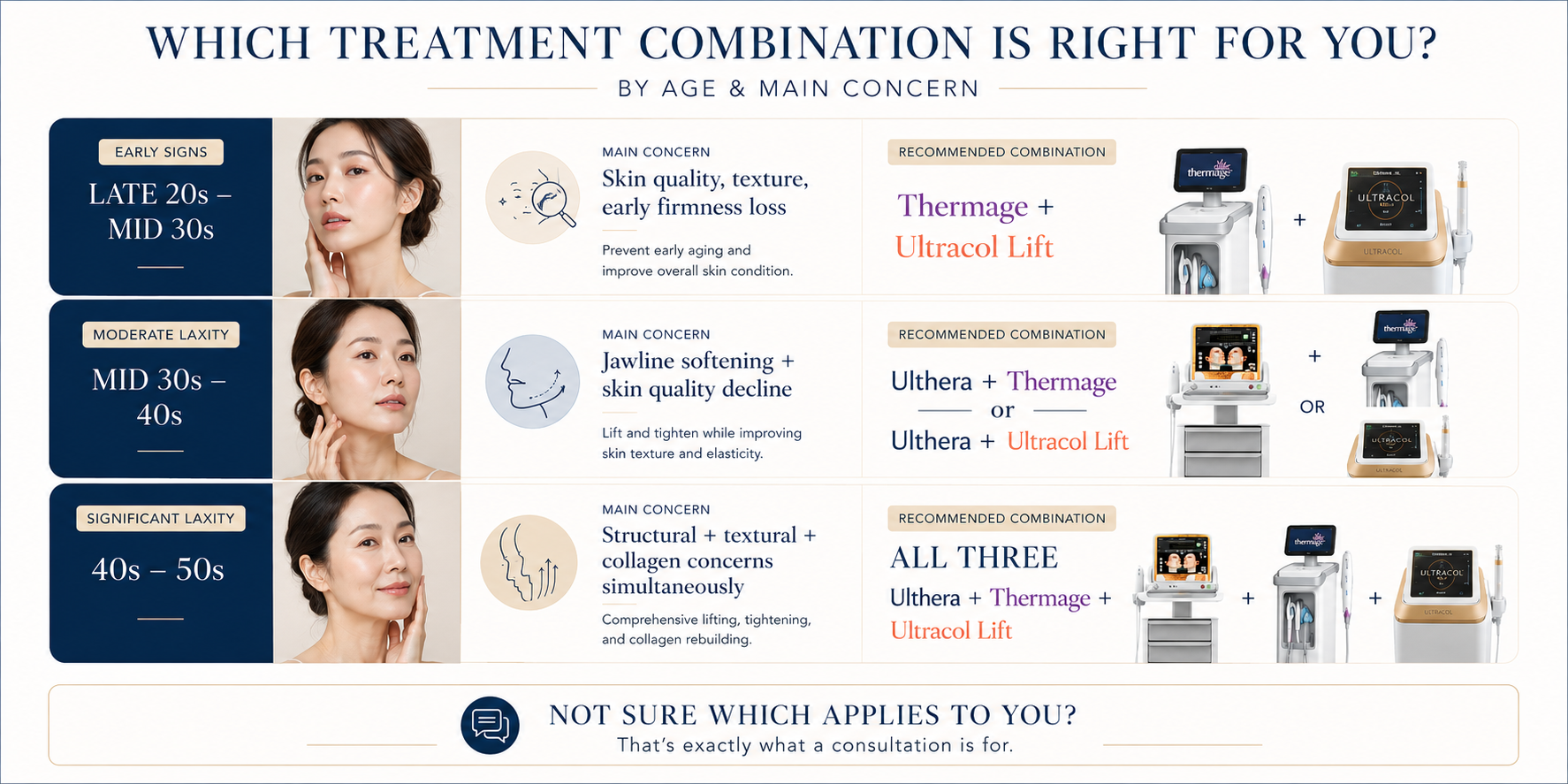
Not everyone needs all three. The right protocol depends on which layers are showing the most change — and that's different for every patient.
Here's a general framework:
Early signs of aging (late 20s–mid 30s) Collagen decline beginning. Skin feels slightly less resilient. Texture and pore changes starting. → Thermage and/or Ultracol Lift likely most relevant
Moderate laxity (mid 30s–40s) Jawline beginning to soften. Skin quality declining alongside structural changes. → Ulthera + Thermage or Ulthera + Ultracol Lift combination
More significant laxity (40s–50s) Multiple layers showing change simultaneously. Structural, textural, and collagen concerns present at once. → All three treatments, sequenced appropriately
This framework is a starting point — not a prescription. The actual recommendation at Ireraum Clinic comes from assessing what's happening in your skin specifically, not from a general age-based protocol.
The IRERAUM Approach: Diagnosis Before Recommendation
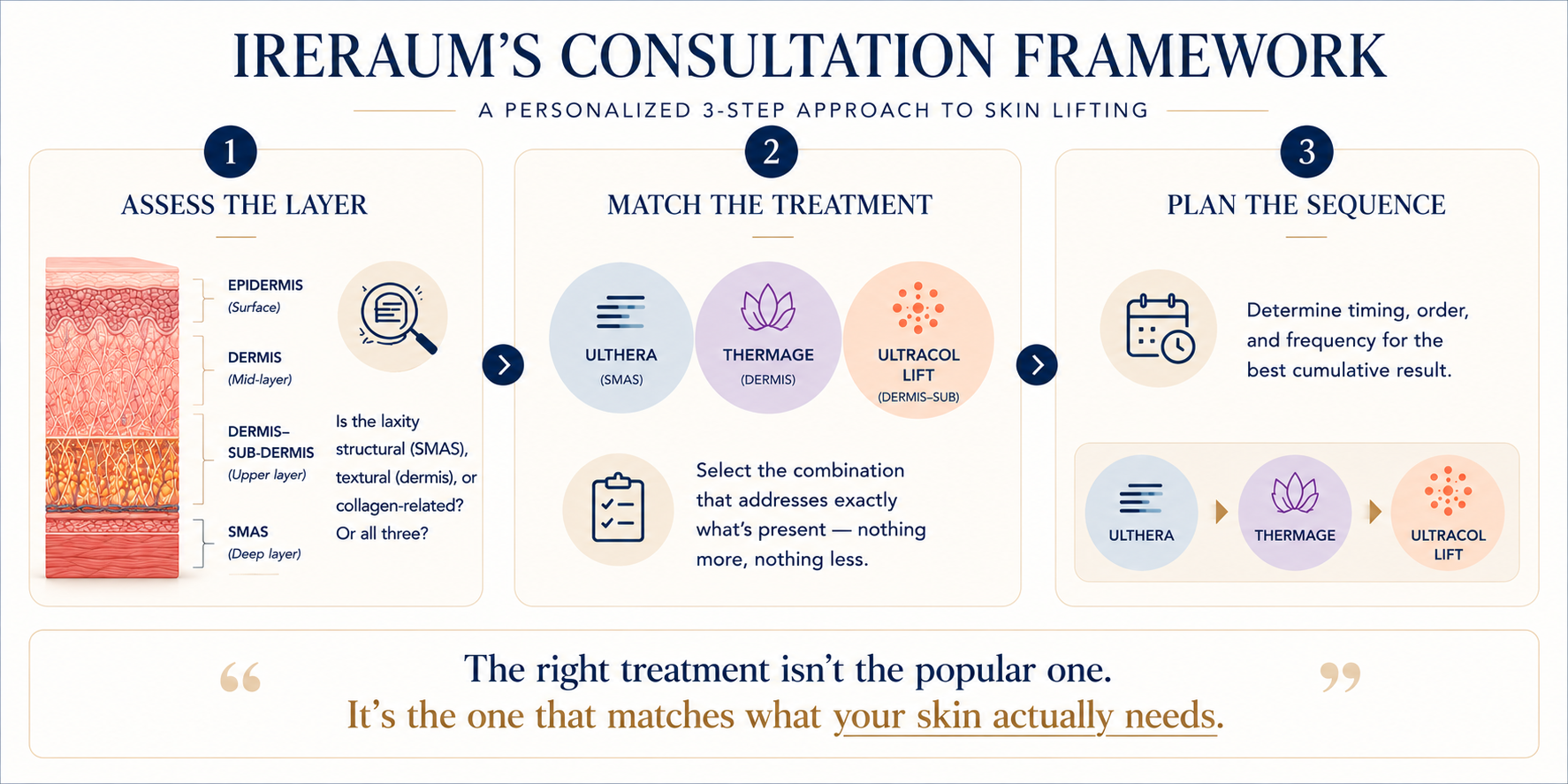
At IRERAUM Clinic, the starting point for any anti-aging consultation isn't a treatment menu. It's a question: what is actually causing the laxity in front of us?
Because laxity that comes from SMAS loosening needs a different answer than laxity that comes from collagen decline. A face that looks tired because of surface texture changes needs a different approach than one that has lost structural definition. Treating the wrong layer — or treating only one layer when multiple are involved — produces a result that misses.
Before recommending any combination, the clinic assesses:
- Whether the concern is structural (SMAS), textural (dermis), or collagen-related (sub-dermis) — or all three
- Which layer is showing the most significant change
- Whether a single treatment or combination approach is most appropriate
- What sequence and timing makes clinical sense for your skin
The result is a treatment plan built around your skin's specific presentation — not the most popular treatment, not a fixed package, not a decision made before the consultation has started.
Frequently Asked Questions
Q. Can I get all three treatments in the same session?
In many cases, yes. Because Ulthera, Thermage, and Ultracol Lift target different layers, they can be performed in combination without conflict. The appropriate sequencing and timing depends on your skin condition and is confirmed at consultation.
Q. Which lasts longest — Ulthera, Thermage, or Ultracol Lift?
Ulthera typically holds longest — 12 to 18 months. Thermage and Ultracol Lift generally last 6 to 12 months. Because all three are collagen-stimulating treatments, results build gradually and compound over multiple sessions.
Q. Is there downtime? All three treatments involve minimal to mild downtime. Redness and mild swelling can occur and typically resolve within a few days. Bruising is possible with Ultracol Lift injections. Most patients return to normal activity quickly.
How do I know which treatment I actually need?
This is the consultation question. Until your skin is assessed — which layer is showing the most change, what's driving the laxity — it's not possible to give an accurate answer. What looks like a surface concern is sometimes a structural one, and vice versa.
Is the combination more expensive than a single treatment?
Combination protocols represent a higher upfront investment, but they address the full picture rather than one layer at a time. Many patients find that a well-designed combination delivers a more complete result than multiple rounds of a single treatment. Cost is discussed transparently at consultation.
When will I see results?
All three treatments stimulate collagen responses that build over 1–3 months. Ulthera's structural lifting typically becomes visible first. Thermage's surface improvements follow. Ultracol Lift's quality improvement builds most gradually, often peaking at month 2–3. The combined effect continues to develop over the following months.
The Bottom Line
Skin laxity isn't one problem. It happens across multiple layers, for multiple reasons, at different rates for different people.
Ulthera lifts the structure. Thermage refines the surface. Ultracol Lift rebuilds the collagen from within. Together, they address the full picture in a way no single treatment can.
The question isn't which one is best. It's which combination is right for your skin — and what layer actually needs attention.
That's the conversation worth having.