You noticed the change gradually.
Not a dramatic shift — just the slow, quiet way your face stopped bouncing back the way it used to. The jawline a little softer. The skin a little less taut. Nothing dramatic enough to explain to someone else, but present enough that you've started researching.
If you've looked into non-surgical lifting options, you've probably come across Ultracol Lift. And the question almost everyone asks before booking is the same:
How long does it actually last?
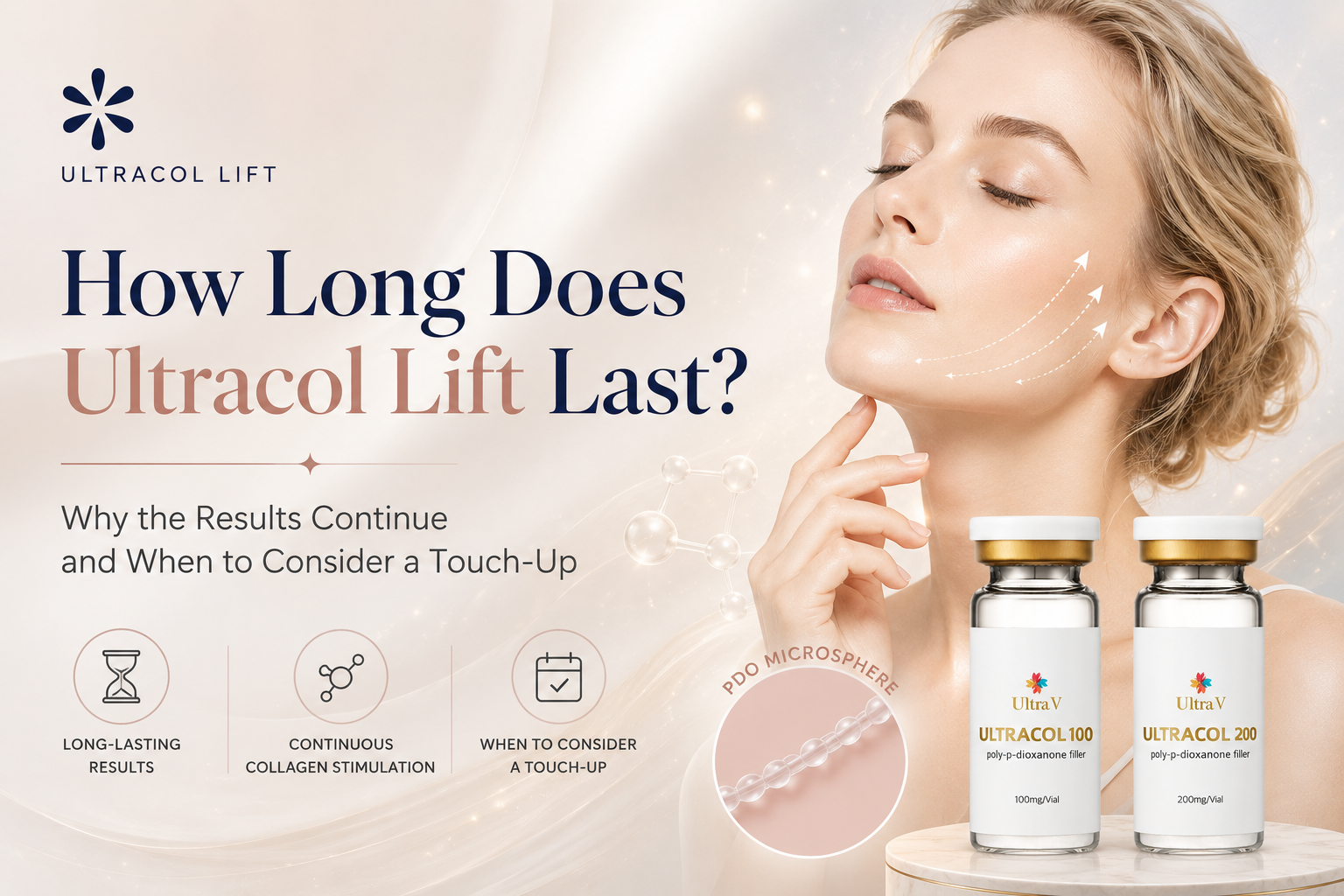
The honest answer: for most patients, 6 to 12 months. But that range exists for real reasons — and understanding what drives it is what helps you decide whether Ultracol Lift is right for your skin, and what to expect when it is.
This guide covers exactly that: how long the results last, why they last as long as they do, what affects the timeline, and when retreatment makes sense.
First: What Is Ultracol Lift, and Why Does Duration Matter?
Ultracol Lift is a PDO (Polydioxanone) microsphere collagen-stimulating treatment. It's not a thread lift. It's not HIFU. And it's not a filler.
The distinction matters for understanding duration — because Ultracol Lift works through a fundamentally different mechanism than most non-surgical lifting treatments.
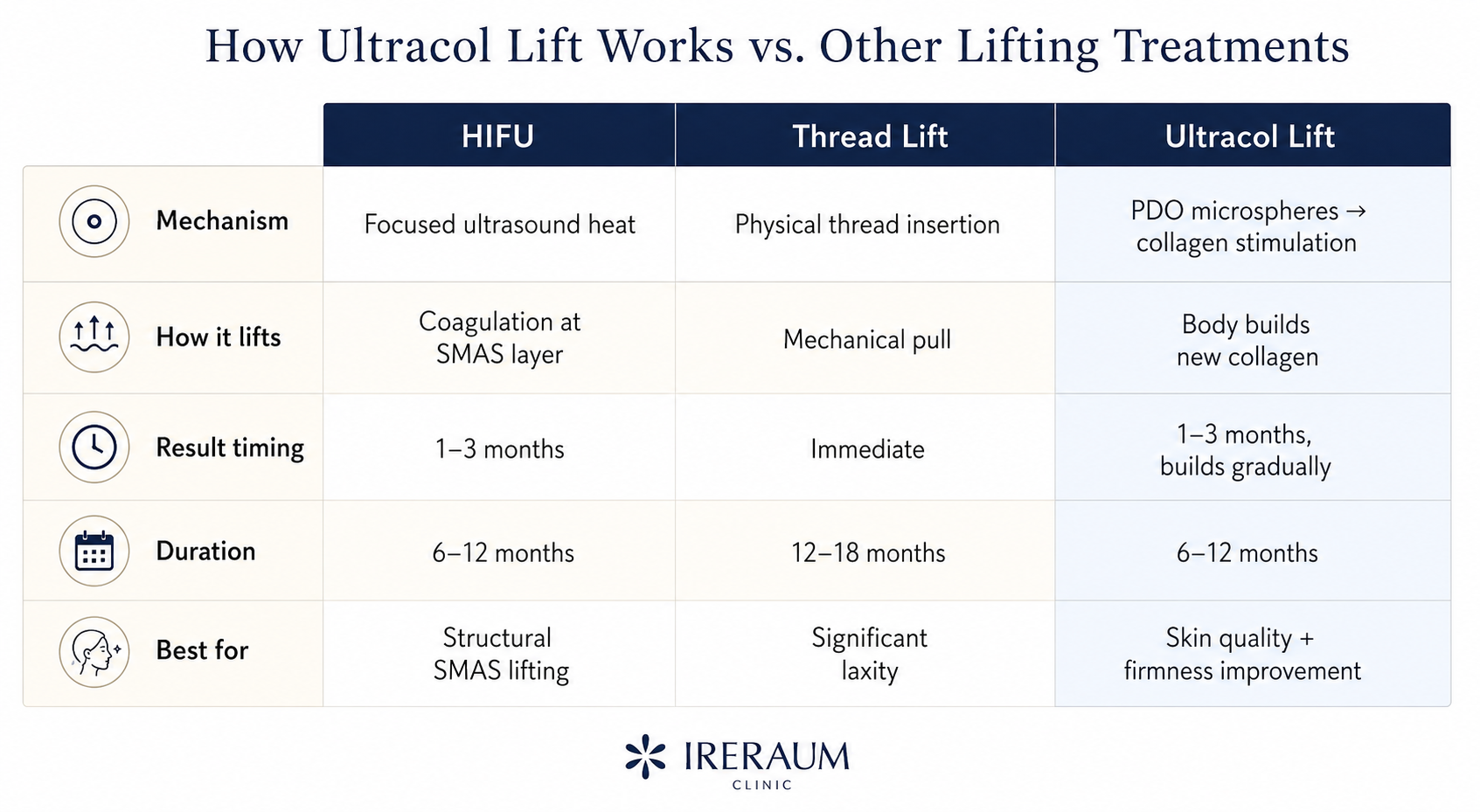
Rather than lifting the skin physically (the way threads do) or using focused ultrasound to create coagulation points (the way HIFU does), Ultracol Lift works by introducing PDO microspheres into the skin — prompting the body's own collagen production process. The PDO is gradually absorbed over time, and the collagen that forms in response is the actual result.
Which means: the result isn't something that gets added and then fades. It's something your skin builds — and then continues to hold.
That's why the duration question is more nuanced than it seems.
Thinking About Ultracol Lift? Here's How Long Results Really Last, And Why It Depends on You
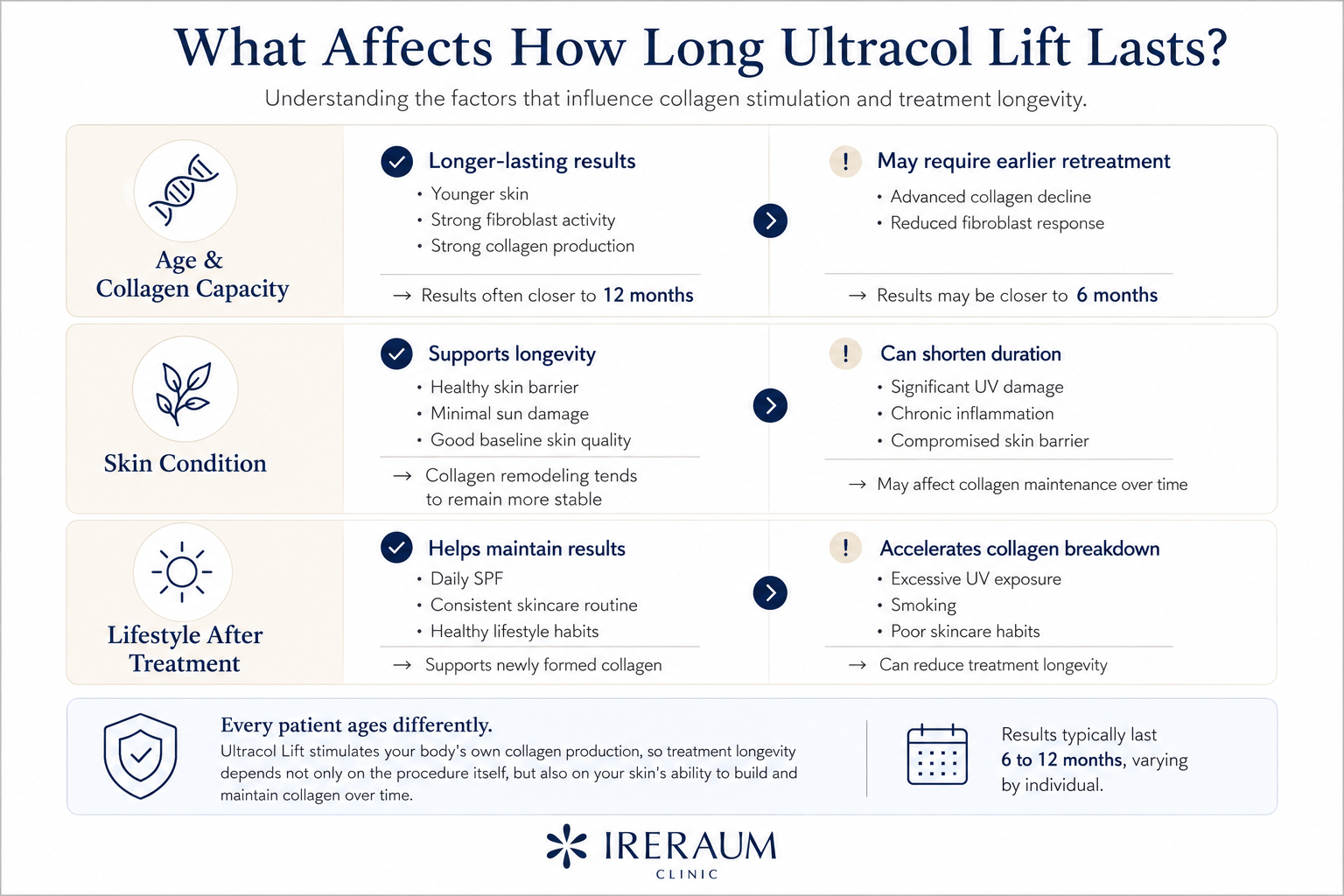
One of the most important things to understand about Ultracol Lift is that the treatment itself is only one factor influencing results.
Because Ultracol Lift relies on collagen stimulation rather than a mechanical lifting effect, the quality of your skin and your body's collagen response play a significant role in treatment longevity. Patients who consistently protect their skin from UV damage and maintain a healthy skincare routine often see longer-lasting improvements.
The goal is not simply temporary lifting, but gradual collagen remodeling that supports firmer, healthier-looking skin over time.
Why Ultracol Lift Lasts as Long as It Does
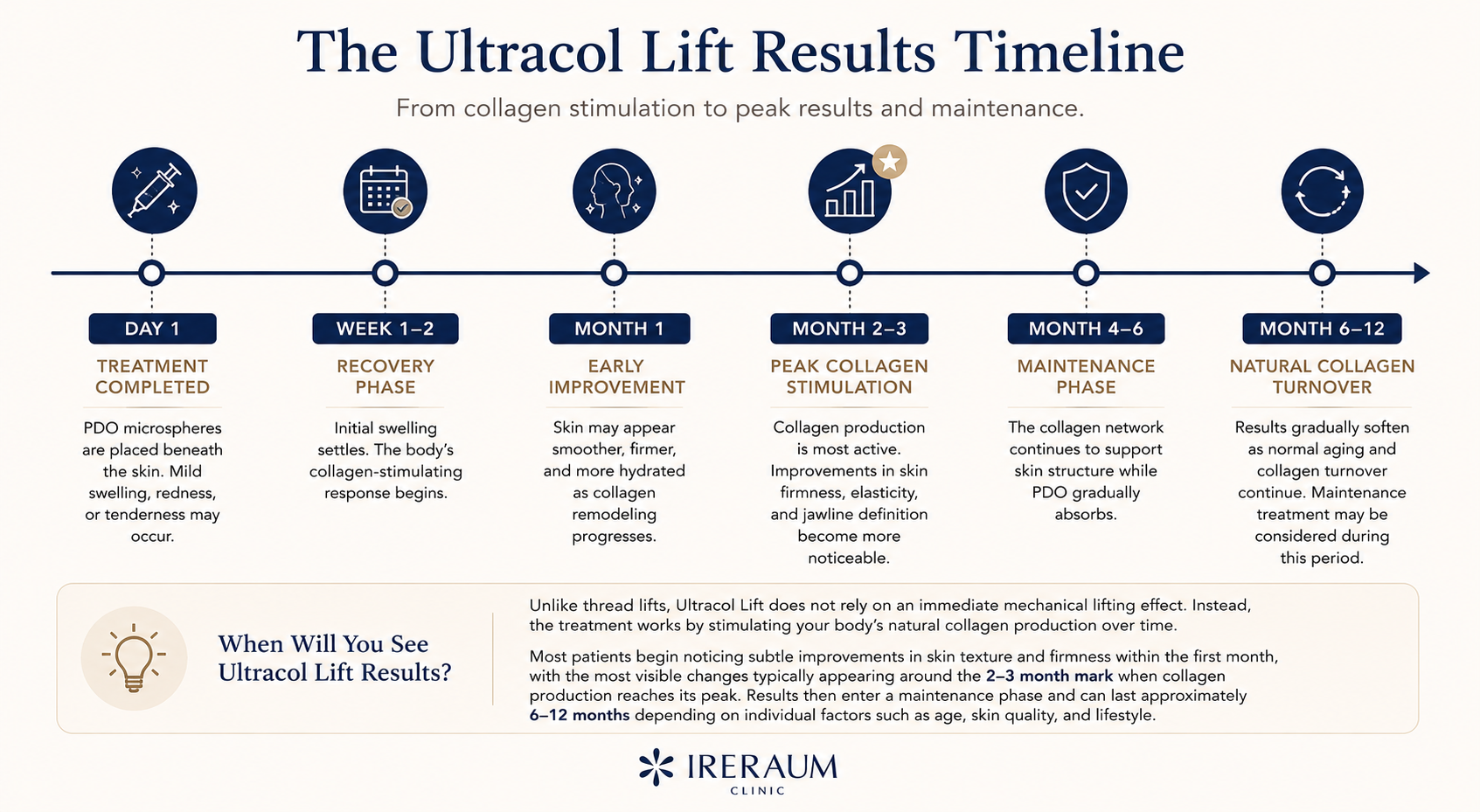
Most patients expect a treatment to work immediately and then fade. Ultracol Lift doesn't follow that pattern — and understanding why explains both the results timeline and the duration.
PDO stimulates collagen. Collagen takes time to form. But once formed, it holds.
When PDO microspheres are introduced into the skin, the body recognises them and initiates a mild healing response. Collagen forms around the microspheres. As the PDO gradually absorbs over several months, the collagen matrix it created remains. That matrix is what you're feeling as firmness — and it's structurally integrated into the skin, not sitting on top of it.
This is why Ultracol Lift feels different from a treatment like HIFU — which creates immediate coagulation points but doesn't leave behind new collagen structure in the same way. The Ultracol result builds more slowly, but what's built is genuine skin tissue — not a temporary effect.
The result begins to fade as the collagen matrix naturally turns over — which, in healthy skin, takes 6 to 12 months. Retreating before that turnover is complete generally means building on an already strong foundation, which is why patients who maintain a consistent Ultracol protocol often notice cumulative improvement over time.
When Will You Actually Feel a Difference?
This is the part most patients want to know before they commit — and it's worth being honest about.
| Timeframe | What to Expect |
|---|---|
| Immediately after | Mild tightening sensation. Some patients notice nothing immediately. |
| Week 1–2 | Mild redness and swelling settle. Skin feels slightly more hydrated. |
| Month 1 | Early firmness. Subtle improvement in skin quality. |
| Month 2–3 | Jawline refinement and skin texture improvement become more visible. This is when most patients say "I can see it now." |
| Month 6 | Results in peak maintenance phase. |
| Month 6–12 | Natural collagen matrix begins to turn over. Retreatment window. |
The most important expectation to set: Ultracol Lift is not an immediate result treatment. Patients who choose it are choosing a natural, gradual improvement over a dramatic instant change. The payoff is a result that looks like your own skin — not a treatment.
Does Ultracol Lift Last Longer Than HIFU? The Answer May Surprise You
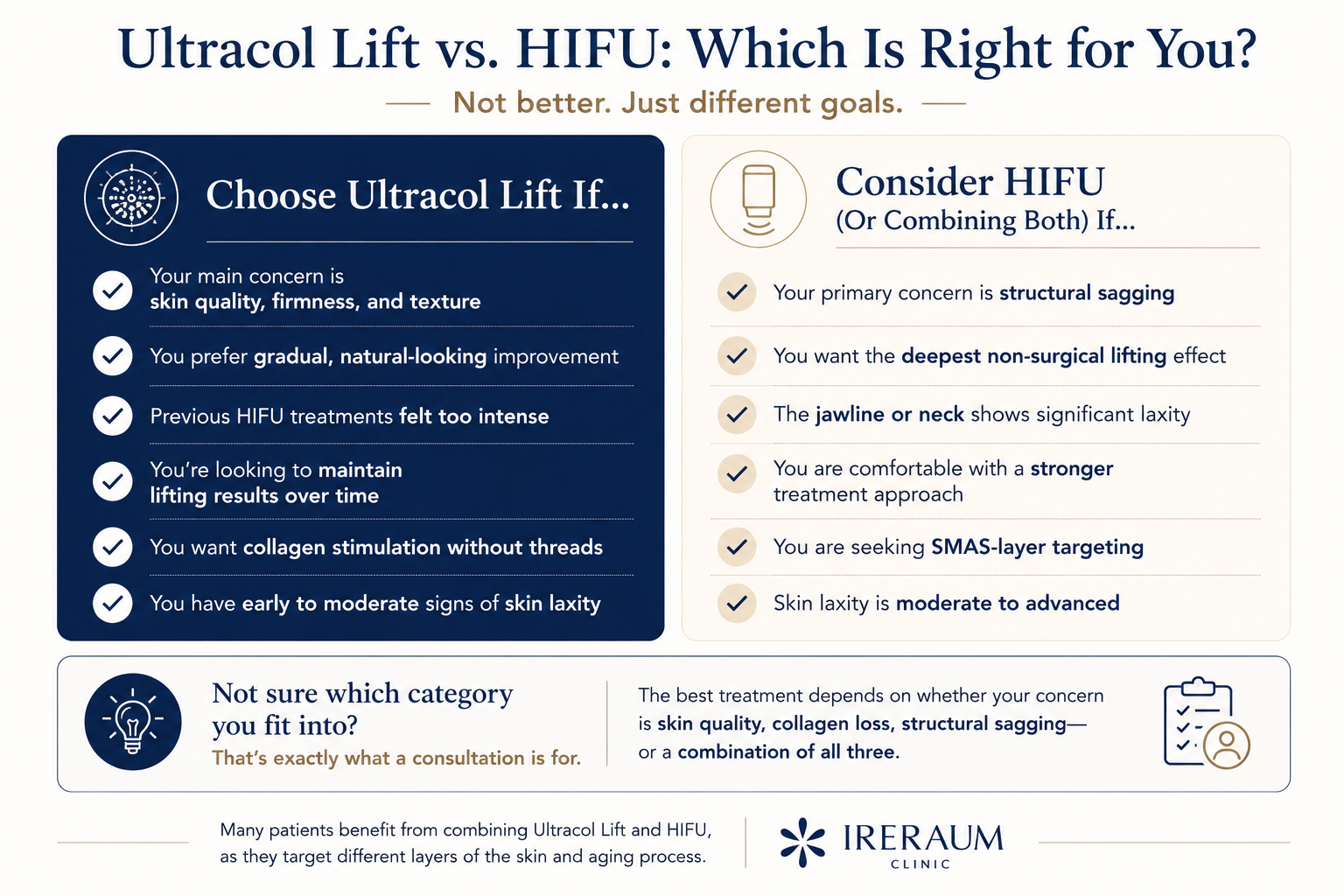
This is one of the most searched questions about Ultracol Lift, and it deserves a direct answer.
Both treatments typically last 6–12 months. But they are not competing for the same result — they address different mechanisms and often complement each other.
HIFU delivers focused ultrasound energy at the SMAS layer — the same structural layer addressed in surgical facelifts. It's the strongest non-surgical option for structural lifting. Its limitation is that it doesn't improve skin quality or texture — it lifts the architecture, but the surface is unchanged.
Ultracol Lift works in the dermis and sub-dermis — stimulating collagen and improving the skin's intrinsic firmness and quality. It's not reaching the SMAS layer. But for patients whose concern is skin quality, texture, and the soft laxity that comes from collagen decline (rather than significant structural sagging), it often delivers a more relevant result.
At Ireraum Clinic, the decision between HIFU, Ultracol Lift, or a combination isn't made by comparing marketing claims — it's made by identifying what's actually causing the laxity in front of us.
When Should You Retreat?
Most patients begin noticing a gradual softening of their results around the 6-month mark — which is the natural signal that the collagen matrix is beginning to turn over and the retreatment window is opening.
Signs it may be time to talk to your doctor:
- The jawline definition you noticed at month 2–3 has softened
- Skin firmness feels like it's returning toward baseline
- You want to maintain the result rather than rebuild from scratch
Why retreating at 6 months (rather than waiting until 12) often makes sense: Treating while some collagen structure is still present means the next round is building on a foundation rather than starting over. Over multiple sessions, many patients notice cumulative improvement — each round producing slightly more than the last, rather than the same result each time.
The timing, as always, should be confirmed by a physician who can assess your current skin condition — not by a fixed schedule.
Pros, Cons, and Who It's Actually For
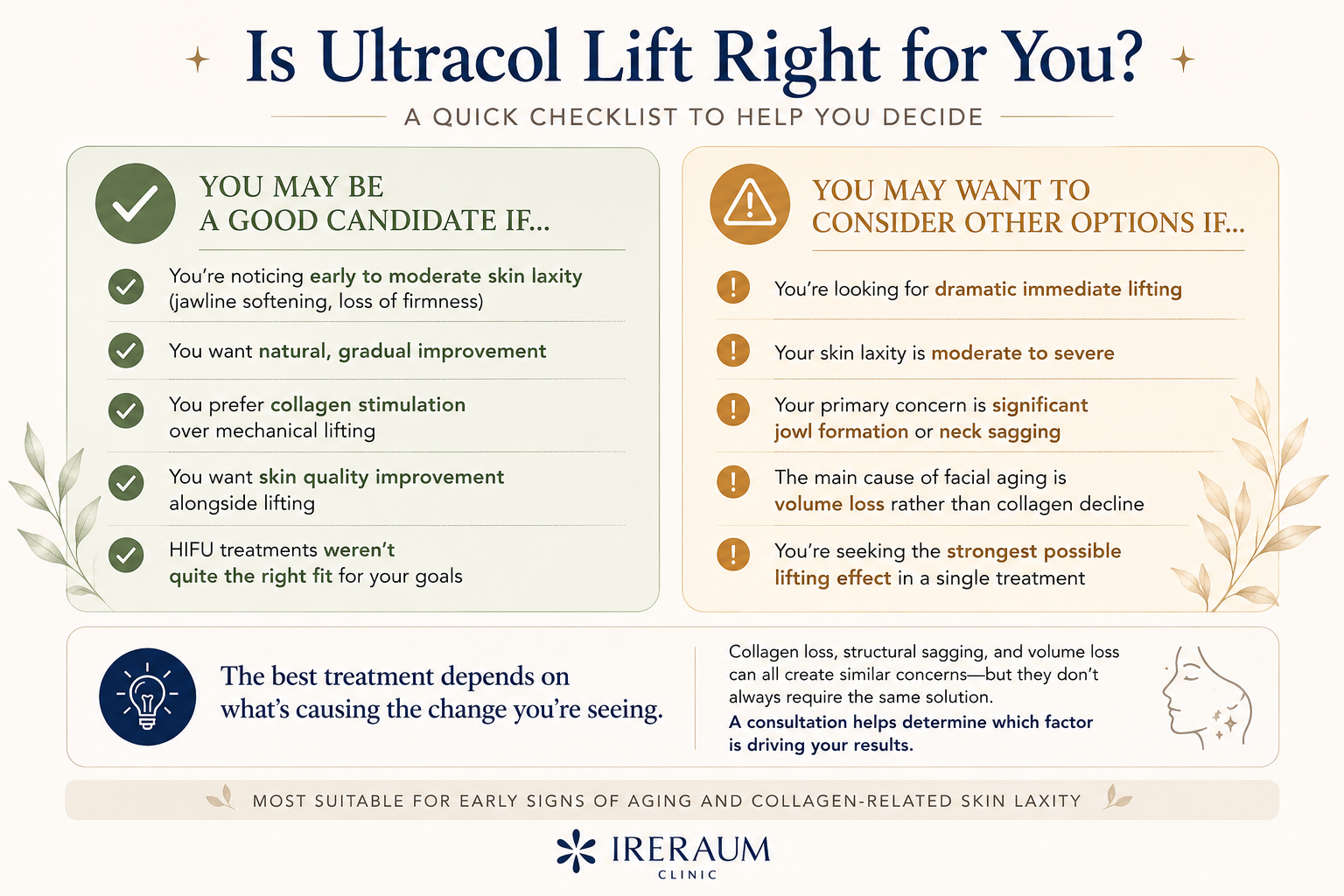
Who Ultracol Lift Works Well For
- Those who want natural, gradual improvement — not a dramatic overnight change
- Those noticing early to moderate skin laxity — jawline softening, loss of firmness — rather than significant structural sagging
- Those who want skin quality improvement alongside lifting — texture, pore appearance, and overall skin health
- Those who have tried HIFU and found the result wasn't quite right for their concern
- Those who prefer not to have threads but want more than topical skincare
Who Should Consider Other Options
- Those wanting immediate, significant visible lifting — Ultracol Lift is gradual by nature
- Those with significant structural sagging — this is surgical or HIFU territory
- Those whose laxity comes from volume loss rather than collagen decline — a different cause needs a different solution
Downtime
| Side Effect | Typical Duration |
|---|---|
| Redness | A few days |
| Swelling | A few days to 1 week |
| Bruising | 1–2 weeks |
Most patients return to normal activity quickly. The visible effects of the treatment itself — not the results, but the post-procedure response — are mild and resolve within 1–2 weeks.
How Ireraum Clinic Approaches the Duration Question
At Ireraum Clinic, we don't lead with duration claims — because how long a result lasts is only meaningful if the treatment is addressing the right cause in the first place.
Before recommending Ultracol Lift, we assess three things:
Is the laxity from skin quality decline? If so, collagen stimulation is the right approach. Ultracol Lift is appropriate.
Is it from volume loss? If the sagging is coming from fat redistribution rather than collagen decline, a different approach is needed.
Is it structural? If the concern is architectural — at the SMAS level — the solution may be HIFU, combination treatment, or a surgical consultation.
Getting this right is what makes the difference between a result that lasts and a treatment that misses. Duration is the outcome of good diagnosis, not just good technique.
Frequently Asked Questions
Q: How long does Ultracol Lift last?
FA.or most patients, 6 to 12 months. Individual results vary based on age, skin condition, and lifestyle.
Q: Does Ultracol Lift last longer than HIFU?
A.Both typically fall in the 6–12 month range. The more relevant question is which one is treating the right concern for your skin — they work through different mechanisms and for different skin presentations.
Q: When will I see results?
A.Most patients begin to notice meaningful change between 1 and 3 months after treatment. The peak result is typically visible around months 2–3, as collagen production reaches its highest point.
Q: How often should I retreat?
A.Most patients consult around the 6-month mark. Some hold results closer to 12 months. The right timing depends on your skin's response and is best confirmed at a follow-up assessment.
Q: Is there downtime?
A. Mild redness, swelling, and possible bruising for 1–2 weeks. Most patients return to normal activity within days.
Q: How is Ultracol Lift different from a thread lift?
A. A thread lift uses physical threads to mechanically pull and hold the skin. Ultracol Lift uses PDO microspheres to stimulate collagen production — no physical pulling, no threads. The result is more gradual, and the improvement is in skin quality and firmness rather than mechanical repositioning.
The Bottom Line
Ultracol Lift lasts 6 to 12 months for most patients — because it's built on a process your skin actually does, not a temporary addition from outside.
The result is gradual. It builds over months. And when it's applied to the right skin concern — early to moderate laxity driven by collagen decline — it produces the kind of improvement that looks like you, just more rested and more firm.
If you're trying to decide whether it's the right treatment for your skin, that's a conversation worth having with your physician — not a decision to make from a duration table alone.